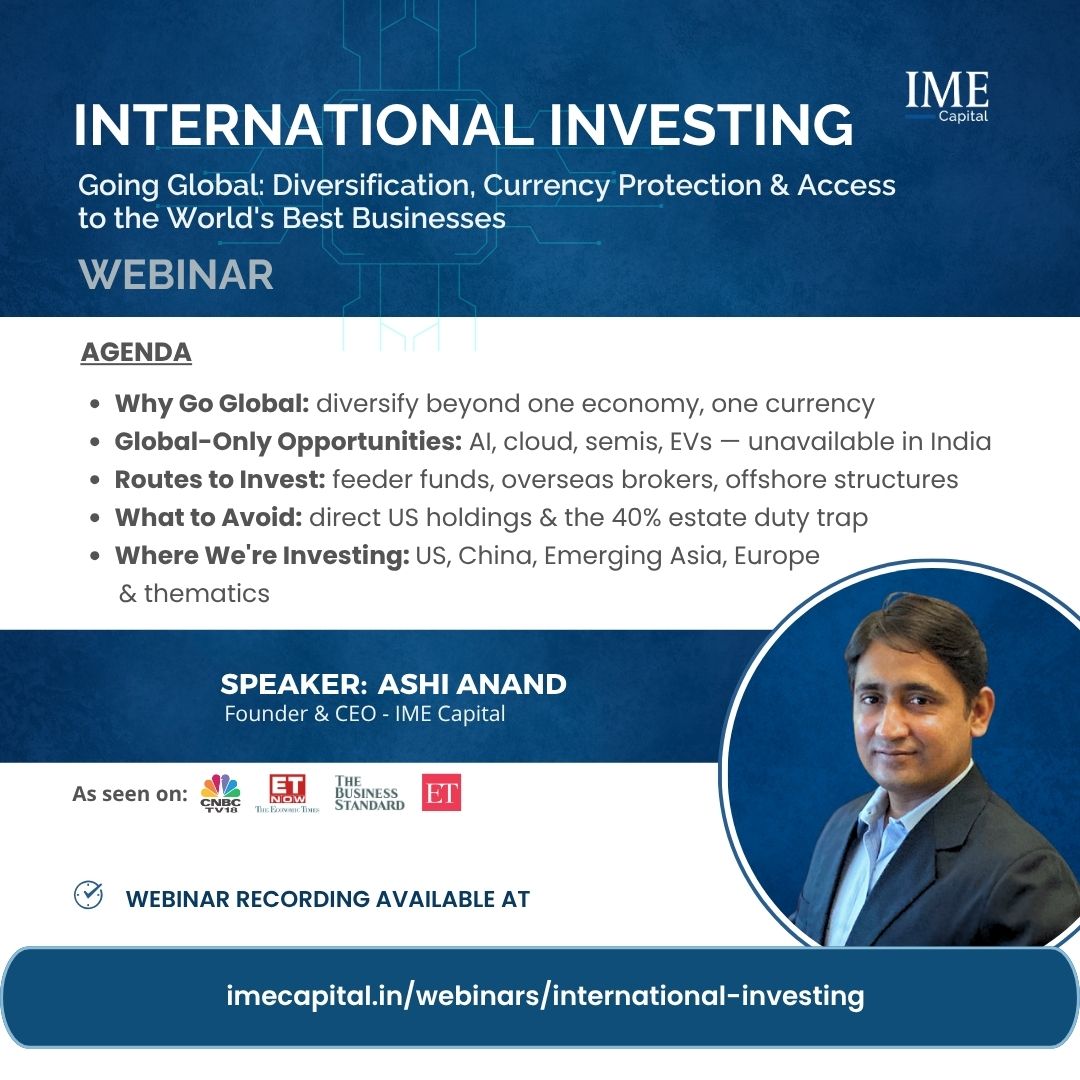
International Investing Webinar
Going Global: Diversification, Currency Diversification & Access to the World's Best Businesses
Why Global Diversification Belongs in an Indian Portfolio
Concentrating an entire portfolio in a single economy and a single currency is a risk most investors take without ever deciding to take it. In this session we set out the case for a global allocation — the diversification and currency benefits, access to trends like AI, cloud software and electric vehicles that have no meaningful Indian-listed equivalent, and the practical routes available to Indian investors, with an honest view of the trade-offs each one carries.
Watch the recording below.
Watch Webinar Recording
About the Webinar
A Single-Country Portfolio Is a Concentrated Position
Most Indian investors hold portfolios that are entirely exposed to one economy, one currency and one policy regime. This rarely registers as a risk decision, because it was never made deliberately — it is simply where the default options led.
We began by reframing that default. India accounts for a small share of global market capitalisation, which means a domestic-only portfolio leaves the overwhelming majority of the world's listed companies outside the opportunity set. Add to this the long-term tendency of the rupee to depreciate against the dollar, and a global allocation starts to look less like an exotic addition and more like a correction to an unintended concentration.
Trends You Simply Cannot Access Domestically
Diversification is the defensive argument. The offensive one is access.
Several of the most significant structural trends of this decade, including artificial intelligence, cloud software, semiconductors and electric vehicles, have no meaningful pure-play representation on Indian exchanges. An investor who wants genuine exposure to these themes has to look outside India to get it. We walked through where these opportunities actually sit, and why participating in them through global funds is a materially different proposition from buying the Indian companies that supply services into them.
The Route You Choose Matters More Than Investors Expect
Getting global exposure is straightforward. Getting it through the right structure is where the real work lies, and this is where we spent much of the session.
We compared the three main routes open to Indian investors — India-based international feeder funds, direct investment through an overseas broker, and international fund structures — across the dimensions that actually determine outcomes: taxation, remittance and LRS mechanics, reporting and compliance burden, capacity constraints, cost, and estate exposure. The direct-broker route in particular deserves careful thought, since holding US-listed securities directly creates US-situs assets and the estate duty consequences that follow. Convenience at the point of investing can carry a considerable cost later.
Where the Opportunities Sit Today
We closed with the practical layer — the specific options we find most attractive. This covered regional equity funds across the US, China, Emerging Asia and Europe, thematic funds targeting the structural trends discussed earlier, and the broader set beyond equities: global fixed income, unlisted funds, and alternatives.
The takeaway was not that investors should move a large share of their portfolio offshore. It was that a considered global allocation, built through the right structure, improves the risk-return profile of an Indian portfolio in ways that are difficult to replicate domestically — and that the structuring decision deserves at least as much attention as the choice of fund.
About the Speaker

Founder & CEO - IME Capital
Ashi Anand is the Founder & CEO of IME Capital. He comes with over 25 years of fund management experience, at some of India's top AMCs including ICICI Pru & Kotak. Over this period, Ashi has been able to consistently outperform the markets, over a wide range of different investment strategies & market conditions.
Some of Ashi's key achievements include:
- ICICI Pru PMS Deep Value (#3 out of 127 funds)
- Allegro Healthcare (strong outperformance when most PMS firms struggled to perform)
- Valcreate IME Digital Disruption (#4 out of 379 PMS schemes)
- Responsible for the launch of India's first Arbitrage Fund (2003) & Capital Guaranteed Fund - CPPI (2004)
Experience the benefits of working with a 'research-first' investments firm
Free 15-Day Trial of IME RMS App
Enjoy a complimentary 15-day trial of IME RMS and 3 1-hour consultations with a Senior Private Banker.
Access IME’s central research insights across MFs, PMSs, AIFs, SIFs and global funds, along with personalised support on risk profiling, mandate design, financial planning, and a portfolio review.
Experience the difference a research-first, transparent approach can make to your wealth journey.