What does a credit rating indicate in terms of actual default risk?

Written by IME Capital's Investor Desk on 28-Jan-26 |
Fixed Income

A credit rating is best thought of as a probability-of-default signal, not a guarantee. Rating agencies assess an issuer’s ability and willingness to meet obligations based on business strength, balance sheet, cash flows, industry conditions, and governance. But defaults are ultimately driven by what happens in the future—economic cycles, sector shocks, liquidity conditions, policy changes, and company-specific events—so historical default rates are only an indicator, not a prediction (and ratings can change as conditions evolve).
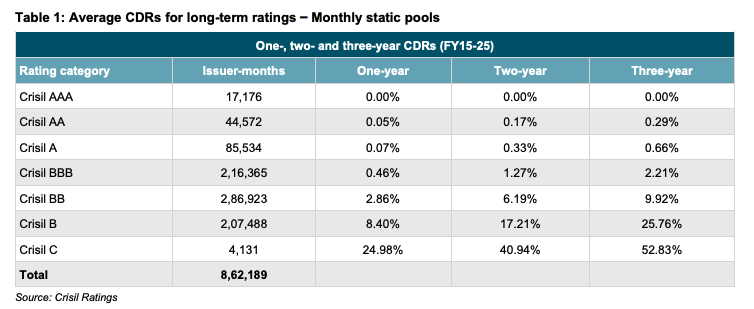
That said, if you want a practical sense of what ratings have meant historically in terms of realised defaults, default studies are a useful reference point. For example, the CRISIL default data (FY15–FY25 monthly static pools) shows that 3-year cumulative default rates rise sharply as you move down the rating ladder—approximately AAA: 0.00%, AA: 0.29%, A: 0.66%, BBB: 2.21%, then stepping up meaningfully in lower ratings (BB: 9.92%, B: 25.76%, C: 52.83%). In simple terms: higher ratings have historically translated into materially lower default incidence over a 3-year window, while lower-rated credit carries a meaningfully higher chance of default.

The right way to use this is as a baseline calibration: in the absence of deeper issuer-level analysis, default-rate history helps translate “AAA vs A vs BBB” into a rough sense of relative default risk. But investors should still treat it as directional—because the next stress cycle can look very different—and combine it with portfolio safeguards like diversification, maturity matching, liquidity planning, and avoiding excessive yield-chasing.

IME Capital Investment Queries provide answers to common investor queries that are directly written by IME Capital's Central Investment Team. This helps ensure centralised, common and transparent communication of our thoughts to all investors (& potential investors) of IME Capital, and helps mitigate against the disparate communication common in the wealth management industry. Please note, that the answers to these queries can be time/market-condition sensitive, or only applicable to specific types of investors.
IME Capital Logo

IME Capital is a research-first investments firm. We aim to disrupt the wealth management industry, by shrinking the gap in investment insights between central research teams & RMs/Clients.

Disclaimer MF/PMS/AIF/Direct Equities are all subject to market risks. Please read the scheme information and other related documents carefully prior to investing. Past performance is not indicative of future returns. Please consider your specific investment requirements before choosing a fund or designing a portfolio that suits your needs. Market & other data on this site has been sourced from what are considered to be reliable sources. All views shared (product ratings, views on individual securities etc.) are the proprietary property of IME Capital and cannot be used in any form without explicit written consent. IME Capital Pvt. Ltd. makes no warranties or representations, express or implied, on products offered through the platform (and that of our partners) or on the correctness of data & views shared. It accepts no liability for any damages or losses, however caused, in connection with the use of, or on the reliance of its product or related services. Detailed Disclaimer | © 2021 All rights reserved | ARN No: ARN-182445