Level 1-5 Investing
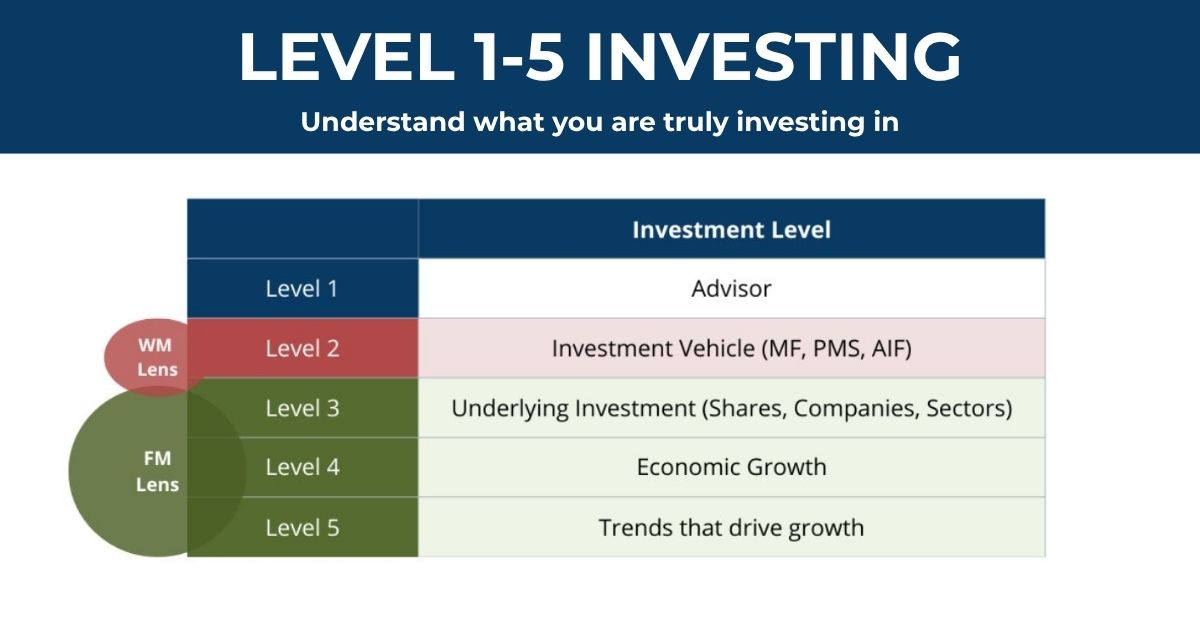
The concept of Level 1-5 Investing helps explain what you are truly investing in, when you select an investment fund (MF, PMS & AIF).
The typical issue is that often investors focus on evaluating funds in isolation, as compared to understanding that they are only vehicles that give you ownership in underlying companies (debt or equity), the performance of which is driven by growth & trends of the economy that these companies operate in. A fund’s performance is accordingly directly linked to the growth of the underlying businesses, economies & economic trends. This perspective can make all the difference, in terms of how we select funds and construct your portfolio.
Working Backwards & the Importance of Each Level
Smart investing works backwards. You need to focus the bulk of your energy on the Level 3-5 exposures you desire (the kinds of companies, economies & economic trends that you wish to invest in), and then with the help of your investment advisor (Level 1), identify the Level-2 funds that will give you those Level 3-5 exposures.
This approach leads to a much superior portfolio, as compared to a portfolio built focusing on fund selection.
Every Level has it’s own Importance!
The Problem of Over-focusing on Level 2 Fund Selection
Unfortunately, most relationship managers & investors end up over focusing on analysing Level-2 funds, resulting in all forms of fundamental portfolio construction errors including:
- Spending time asking the wrong questions: Too much of investor-advisor conversations tend to be focused on Fund A vs Fund B, as compared to questions that are much more material to wealth generation (the right types of companies, the right economic exposures, exposures to specific economic trends)
- Confusing real hard assets for volatile NAVs/fund performance): When you invest in a fund, you are ultimately investing in part ownership of businesses in an economy & sector. Business ownership is a highly tangible & real asset. If investors were to look at their investment portfolios in the right manner (ownership of real businesses) their investment behaviour & discipline would be substantially superior to when they look at this as volatile NAVs of paper financial securities.
- Meaningless Diversification: Investing in multiple funds (for example 4 large-cap funds, all giving you exposure to similar blue chip companies in India), as compared to true diversification (4 funds – one India large-cap, one India mid-cap, one US technology, one Indian sectoral fund)
- Focusing on fund performance in isolation: The most common way of selecting a fund is to look at its performance. This often leads to a problem of investors getting into funds at the wrong time. For example, investors made large allocations to small-cap funds in 2017 & 2018 driven by very strong past performance, not recognising that the small-cap rally had possibly over-extended and the larger impact of the IL&FS funding crisis on smaller companies. Such investors accordingly saw large losses as small-caps corrected.
Experience the benefits of working with a 'research-first' investments firm
Free 15-Day Trial of IME RMS App
Enjoy a complimentary 15-day trial of IME RMS and 3 1-hour consultations with a Senior Private Banker.
Access IME’s central research insights across MFs, PMSs, AIFs, SIFs and global funds, along with personalised support on risk profiling, mandate design, financial planning, and a portfolio review.
Experience the difference a research-first, transparent approach can make to your wealth journey.